
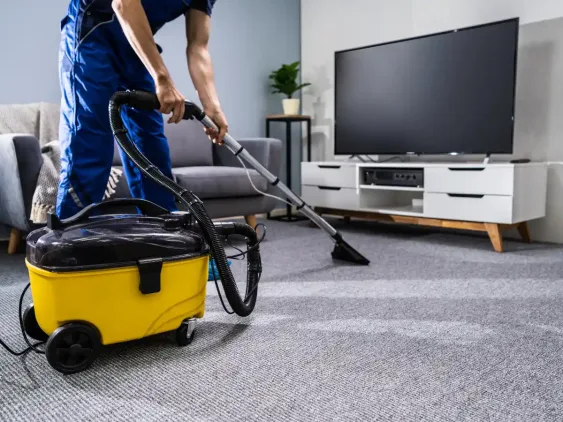
Buried grit grinds against carpet fibers every time someone walks across it? By the time traffic lanes show up in your lobby, the damage has been building for months.
That’s why it’s important for businesses to invest in commercial carpet cleaning.
But what actually happens during a professional carpet clean? Are there different methods? How much does commercial carpet cleaning cost? Let’s talk about it in this guide.
Jump to:
- What Is Commercial Carpet Cleaning?
- What Is Involved in Commercial Carpet Cleaning?
- Common Commercial Carpet Cleaning Methods
- How Much Does Commercial Carpet Cleaning Cost?
- Extra Cleaning Needs That Can Affect Price
- How Often Should Commercial Carpets Be Cleaned?
- What to Look for in a Commercial Carpet Cleaning Provider
- Frequently Asked Questions About Commercial Carpet Cleaning
- Get an Accurate Commercial Carpet Cleaning Quote With Desert Oasis Commercial Cleaners
About Desert Oasis Commercial Cleaners
Desert Oasis Commercial Cleaners has cleaned commercial carpets across the Phoenix Metro area for more than 20 years, in offices, medical clinics, retail stores, and more. We hold an A+ rating and maintain HIPAA and OSHA compliance for facilities subject to regulatory requirements. We prioritize low-moisture, fast-drying extraction methods and use sustainable, low-allergen products.
What Is Commercial Carpet Cleaning?
For commercial facilities, carpet cleaning is the scheduled maintenance of carpets, focused on preserving appearance and quality to keep daily operations running. The right method depends on foot traffic, carpet construction, soil level, facility hours, and how quickly the carpet needs to dry.
Unlike standard carpet cleaning in Phoenix, commercial maintenance involves:
- Larger floor areas and heavier traffic loads
- Cleaning schedules built around business hours
- Faster drying requirements to limit downtime
- Different methods for high-traffic and low-traffic zones
- Interim maintenance between deeper extraction services
So for facility and property managers, the real question isn’t whether the carpet can be cleaned. It’s which method delivers the result with little to no downtime.
Is Your Business Due for a Commercial Carpet Cleaning in Phoenix?
At Desert Oasis Commercial Cleaners, we’ll create a customized cleaning plan for you.
What Is Involved in Commercial Carpet Cleaning?
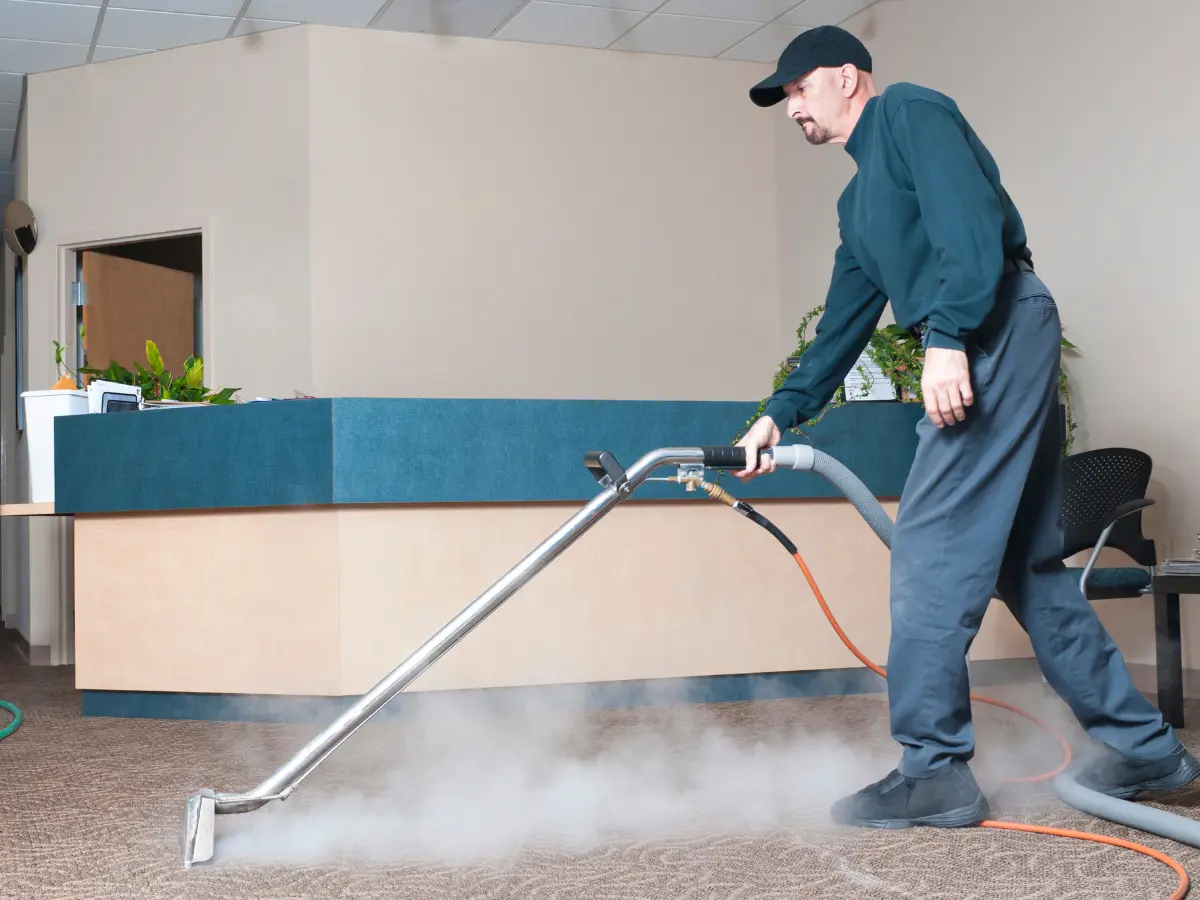
A professional cleaning follows the same sequence in most facilities. Office carpet cleaning for under 5,000 square feet takes three to five hours. Larger facilities run longer or get split across several nights so departments stay open.
The difference is more on how well they can get it done.
Step 1. Inspection and Assessment
The technician identifies the fiber, the backing, and how the carpet is installed. Those three things decide the method.
Nylon handles hot water and alkaline pre-sprays well, so most commercial nylon gets standard hot water extraction. Wool needs a near-neutral pH and lower heat, because alkaline solutions strip its natural oils and cause browning. Olefin and polyester repel water but attract oily soil, so they need a solvent-based pre-spray.
Step 2. Pre-Vacuuming and Debris Removal
Dry soil comes out first, with a commercial upright that has a beater bar. Most of what’s in commercial carpet is dry particulate, not liquid staining.
Add water to dry soil, and you get mud that binds to the fiber. Extraction then pulls out a fraction of what a vacuum would have taken in one pass.
Desert Oasis Advice: Always ask how much time goes into the dry pass in their commercial carpet cleaning process.
Desert Oasis Cleaners spend a large share of the job on pre-vacuuming, especially in Phoenix, because sand and fine grit work their way into carpet backing and act like sandpaper against the fibers. However, a lot of other facilities will skip straight to extraction, which will not properly remove all of the grit.
Step 3. Pre-Treatment of Spots and High-Traffic Areas
Pre-spray goes down on entry paths, corridors, and elevator lobbies, then sits for five to ten minutes. The pre-spray CANNOT dry on the fiber. Dried surfactant leaves residue that attracts soil, and the carpet resoils faster than before it was cleaned.
Walkways usually get a second application. A hallway carries several times the soil of the offices on either side of it.
Step 4. Agitation and Soil Suspension
A counter-rotating brush or rotary machine works the pre-spray from the tip of the fiber down to the base of the pile. Soil sits at the bottom, not the top.
Agitation also lifts matting in traffic lanes. Crushed fibers reflect light differently, which is part of why walkways look darker even when they’re clean.
Loop pile takes a softer brush than cut pile. Aggressive agitation on a Berber loop can fuzz or snag the loops permanently.
Step 5. Deep Cleaning and Extraction
Heated solution goes into the carpet under pressure through a wand or rotary extractor, then comes straight back out with the suspended soil.
Recovery matters more than water volume. Weak extraction leaves moisture in the backing, and as that moisture evaporates, it carries dissolved soil back to the surface. That’s wicking, and it’s why a stain sometimes reappears the next morning.
Step 6. Spot, Stain, and Gum Treatment Where Needed
Anything visible after extraction gets worked on individually, and the residue type sets the chemistry. Coffee and tea are tannin stains that need an acidic agent. Whereas ink and adhesive need a solvent.
Skip to Extra Cleaning Needs That Can Affect Price to learn more.
Step 7. Drying and Airflow
Air movers go down immediately, angled across the carpet rather than straight at it. Moving air across the surface pulls moisture faster than pointing a fan at one spot.
Most hot water extraction jobs dry in six to twelve hours. Low-moisture methods finish in one to two.
Step 8. Final Inspection and Walkthrough
The technician walks the areas flagged in Step 1 with you and confirms each one. Anything that needs a second pass gets handled before the crew packs up.
Desert Oasis Advice: Ask for a follow-up window of about 24 to 48 hours.
That’s the period when wicking shows itself, and a provider willing to come back for it is telling you something about their extraction.
How Often Should Commercial Carpets Be Cleaned?
Most commercial carpet needs professional deep cleaning every 3 to 12 months. Offices with moderate to low traffic can also schedule every 6 to 12 months.
Typical schedules by facility type:
| Facility | General Areas | High-Traffic Zones |
|---|---|---|
| Corporate Offices | Every 6 to 12 months | Every 3 to 6 months |
| Medical and Dental Clinics | Every 3 to 6 months | Quarterly or more |
| Retail Stores | Every 3 to 6 months | Entryways – monthly |
| Schools | Every 6 months, timed to breaks | Every 3 months |
| Hotels and Venues | Every 3 to 6 months | Lobbies – monthly |
| Restaurants | Every 3 months | Dining paths – monthly |
| Warehouses with Carpeted Offices | Annually | Every 6 months |
Common Commercial Carpet Cleaning Methods
Commercial providers use a handful of methods, and the right one depends on the carpet, the soil level, and how fast the space needs to reopen. Most facilities end up using two—a deep method a few times a year and a lighter method in between.
Hot Water Extraction (Steam Cleaning)
Best for: Annual and semi-annual commercial carpet cleaning
Hot water extraction is the deepest clean available and the method most manufacturers name in their warranty requirements.
The name is misleading. There’s no steam involved. Heated water and cleaning solution go into the carpet under pressure, then get vacuumed straight back out with the suspended soil. The visible vapor is a byproduct. It removes the most soil of any method because it reaches the base of the pile and pulls the residue out with it.
Low-Moisture and Encapsulation Cleaning
Best for: Interim maintenance
Encapsulation uses a polymer solution that crystallizes around soil particles as it dries. The crystals hold the dirt in a brittle shell, and the next vacuum pass pulls it out. Very little water goes down, so carpet dries in one to two hours. Crews can clean a corridor at lunch and have it open before the afternoon.
Dry Cleaning Methods
Best for: Facilities that run continuously and can’t give up a floor for even a few hours
Dry compound cleaning spreads an absorbent material carrying solvent and a small amount of moisture across the carpet. A machine works it into the fibers, the compound binds to the soil, and a vacuum removes both.
Carpet is walkable almost immediately. There’s effectively no dry time.
Bonnet Cleaning and Interim Maintenance
Best for: Quick surface refreshes
Bonnet cleaning runs an absorbent pad on a rotary machine across carpet that’s been sprayed with solution. The pad picks up surface soil as it spins. It’s fast and cheap, which is why it’s popular for hotel corridors and office lobbies where appearance matters more than depth.
Desert Oasis Advice: Regular bonnet cleaning doesn’t mean you can skip deep cleans. This process only cleans the top of the fiber, and repeated use without extraction pushes soil deeper into the pile.
How Much Does Commercial Carpet Cleaning Cost?
Commercial carpet cleaning prices generally run $0.15 to $0.20 per square foot. Rates shift with building size, carpet type, and local market conditions, and properties over 20,000 square feet are often quoted closer to $0.10 as crews cover more ground per visit.
In practical terms, a 1,000 square foot office or retail space usually falls between $100 and $300, while mid-sized facilities of 5,000 to 10,000 square feet typically run $500 to $3,000. Jobs with an unpredictable scope—heavy soil, restoration work, or a building nobody has assessed yet—are sometimes quoted hourly instead, and commonly land between $60 and $100 per hour per technician.
Per-Room vs. Per-Square-Foot vs. Flat-Rate Carpet Cleaning Prices
| Pricing Model | How It Works | Best Suited For | Watch For |
|---|---|---|---|
| Per Square Foot | A set rate multiplied by measured area | Open floor plans, offices, retail, most commercial work | Whether the measurement covers total floor area or carpeted area only |
| Per Room | A flat charge per room or defined area | Small suites with clearly divided rooms | Room size caps, since many providers define a room as 200 to 250 square feet and bill overage |
| Flat Rate | One fixed price for the whole job or a recurring contract | Ongoing accounts where the provider knows the space | Exactly which areas and services the flat rate includes |
| Suggested Next Reads: |
Book Commercial Carpet Cleaning in Phoenix That is Actually Worth Your Money
Most facilities don’t need the most expensive service on every visit. They just need the right service from the right people.
Extra Cleaning Needs That Can Affect Price
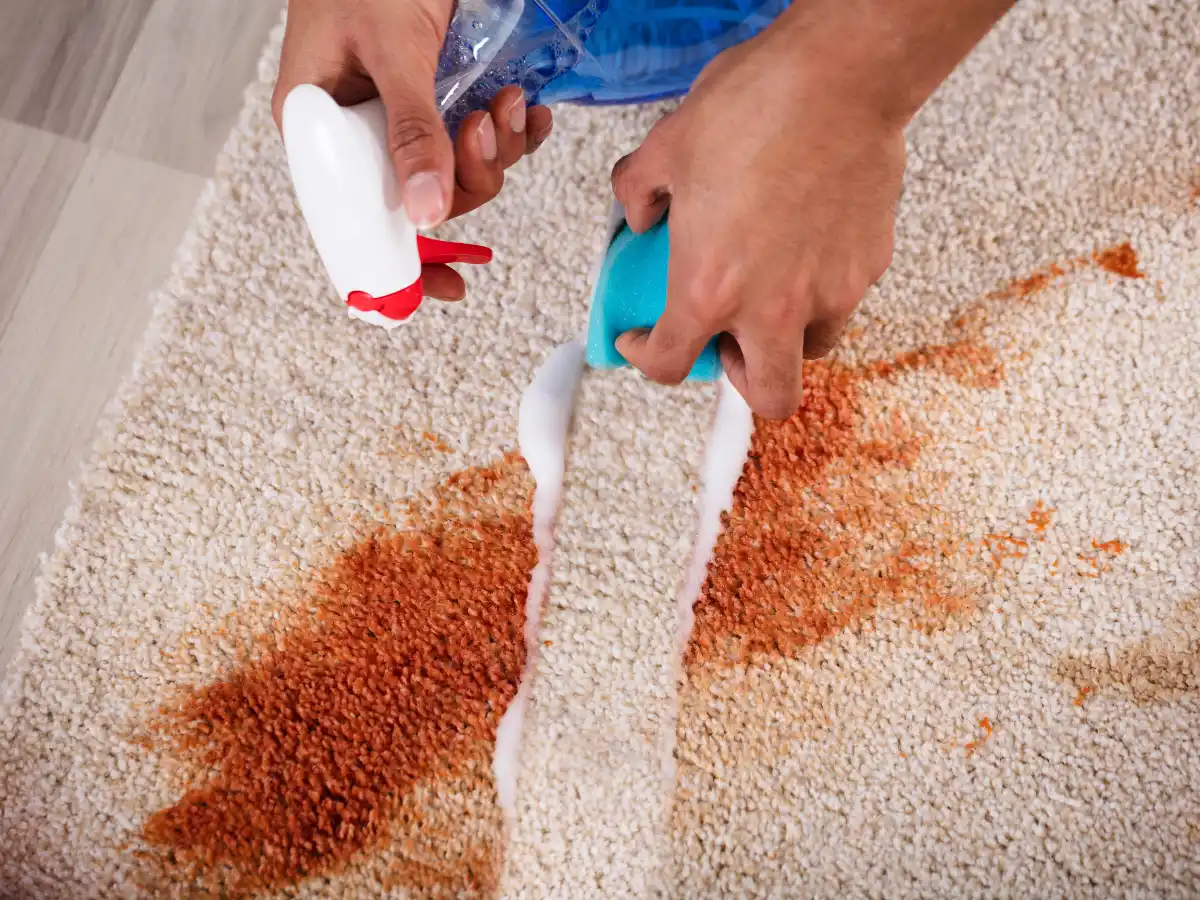
The per-square-foot rate covers general commercial carpet cleaning cost across the measured area. Anything needing individual attention usually gets priced on top of that. Always ask which of these applies to your building before the quote is finalized.
- Chewing gum removal from carpet. Technicians chill the gum until it’s brittle, lift it out in pieces, then treat the residue with a solvent. Fresh gum comes up cleanly, but gum that’s been walked into a lobby floor for weeks presses into the backing and can leave a shadow. Usually billed per piece or by affected area.
- Difficult and set-in stains. Different stains, different solutions. Each commercial carpet stain removal process has its own chemistry, and a technician works by hand instead of covering ground, which is where the added cost comes from.
- Stains that won’t fully lift. Bleach, fertilizer, and colored drink dyes strip or replace the carpet’s color, and nothing can restore color that’s already gone. A good provider flags these during the walkthrough rather than billing.
- Heavy soil buildup. Carpet that hasn’t been extracted in years needs repeat pre-spray applications and multiple passes before the recovered water runs clear. Some providers quote this as restoration work.
- Targeted spot treatments. Entryways, break rooms, and the carpet under printers concentrate soil no matter how clean the rest of the floor is. Treating them as a small scheduled add-on costs less than letting them degrade until the whole floor needs restoration.
- Odor treatment. Enzyme treatment addresses whatever soaked into the backing, and in serious cases, the cushion needs to be treated too. Air fresheners don’t fix odor that’s reached the pad.
- Carpet protectant. Applied while the carpet is still damp, it coats the fibers so spills bead up instead of soaking in. It wears off with traffic and needs reapplying at each cleaning, so treat it as a recurring line item rather than a one-time treatment.
Desert Oasis Advice: Some stains CANNOT be lifted, even after multiple attempts, because they have turned into damage.
A stain sits on the fiber and lifts off with the right commercial carpet stain removal solution, but damage means the fiber’s own color is gone and there’s nothing left to remove. Ask your technician which one you’re dealing with, because if it’s damage, more cleaning attempts only wear the fiber down.
What to Look for in a Commercial Carpet Cleaning Provider
Most commercial carpet cleaning quotes look similar on paper. The differences show up in what the crew actually does on site, which is why it helps to know what separates a thorough provider from a fast one.
Signs of a provider worth hiring
- Walks your facility before quoting
- Names the cleaning method and explains why it fits your carpet
- Spends real time pre-vacuuming before any water goes down
- Quotes line by line, with add-ons priced separately
- Tells you upfront which stains won’t come out
- Schedules around your hours, including evenings and weekends
- Follows up after the job to check for wicking
- Carries insurance and meets your facility’s compliance requirements
Red flags
- Prices quoted before anyone has seen the space
- Carpet left soaking wet for days
- Add-on charges that surface after the work is done
- One method used on every building regardless of carpet type
- Guarantees that every stain will come out
Desert Oasis Commercial Cleaners has cleaned carpet across the Phoenix Metro for more than 20 years, and every one of our quotes starts with a walkthrough of your facility. Our crews use low-moisture, fast-drying commercial carpet cleaning methods so your space is usable in hours rather than days. Cherry on top, we consistently maintain HIPAA and OSHA compliance for regulated facilities.
Frequently Asked Questions About Commercial Carpet Cleaning
How long does commercial carpet take to dry?
Six to twelve hours after steam cleaning, and one to two hours after low-moisture cleaning. Most businesses book evening jobs so the floor is dry by morning.
Can carpet be cleaned during business hours?
Yes, if the crew uses a low-moisture method. Those dry in about an hour, so a hallway can be cleaned at lunch and used the same afternoon. Steam cleaning needs the space empty for several hours, so it usually runs after hours or a section at a time.
Is steam cleaning better than low-moisture cleaning?
Steam cleaning is better at removing dirt. Low-moisture cleaning is better if you need your staff to return to the space faster. Most businesses use both commercial carpet cleaning methods, with steam cleaning a few times a year and low-moisture on busy walkways in between.
Does regular cleaning actually extend carpet life?
Yes. The grit trapped in your carpet acts like sandpaper against the fibers every time someone walks on it. Getting it out on a schedule keeps the carpet from wearing down, and once fibers are worn, nothing brings them back.
Do I really need professional carpet cleaning if I clean my carpets regularly?
Yes. Vacuuming and spot cleaning take care of the surface, but they can’t reach the dirt packed down at the base of the carpet, and that’s what causes wear.
How do I know when commercial carpet needs cleaning versus replacing?
Clean it if the carpet is dirty, but the fibers still stand up. Replace it if the carpet is flattened, worn down to the backing, coming apart, or permanently discolored.
Get an Accurate Commercial Carpet Cleaning Quote With Desert Oasis Commercial Cleaners
Now that you’ve explored everything you need to know about commercial carpet cleaning, the only thing left is to determine when to schedule yours.
At Desert Oasis Cleaners, we measure your carpeted area, check the fiber and installation, review your traffic patterns and point out any spots that need separate treatment. You get a written quote with the scope spelled out, so nothing shows up on the invoice that wasn’t discussed first.
That’s 20+ years of experience for you.